
Deck cost in St. Charles, MO: a 2026 guide by material
Deck builder based in St. Charles, MO, working across St. Charles County.
What do national cost guides say a deck costs?
Start with the published ranges, then adjust for your yard. HomeAdvisor's 2025 guide lists composite at $25 to $54 per square foot installed, and composite boards and framing materials alone at $12 to $22 per square foot. The same guide puts pressure-treated wood at $2 to $5 per square foot for the material, before labor.
Those numbers are national. They include a lot of different decks in a lot of different yards, so treat them as a sanity check on quotes, not a price for yours.
Worked example at HomeAdvisor's composite range
A 12x16 deck is 192 square feet. At $25 to $54 per square foot installed, that's roughly $4,800 to $10,400 for a composite deck before anything unusual about your lot. A 16x20 deck is 320 square feet, which works out to about $8,000 to $17,300 at the same range. Railings and stairs can sit inside or outside those numbers depending on how the guide counted them, which is one reason real quotes vary.
Why composite has such a wide range
Composite board lines differ a lot in price. Trex sells several lines, from Select up through Transcend and Signature, and TimberTech has its own tiers. The higher lines carry longer manufacturer warranties and cost more per board. Cedar boards cost more than pressure-treated pine, so a cedar deck usually costs more than a pressure-treated one of the same size.
What makes one deck cost more than another in St. Charles County?
Size and material set the base. Height, footings, demolition, slope, permits and add-ons decide where a quote actually lands. Two 320-square-foot decks can be thousands of dollars apart because one sits a foot off the grass and the other needs tall posts, a long stair and a guard on every open side.
Height and footings
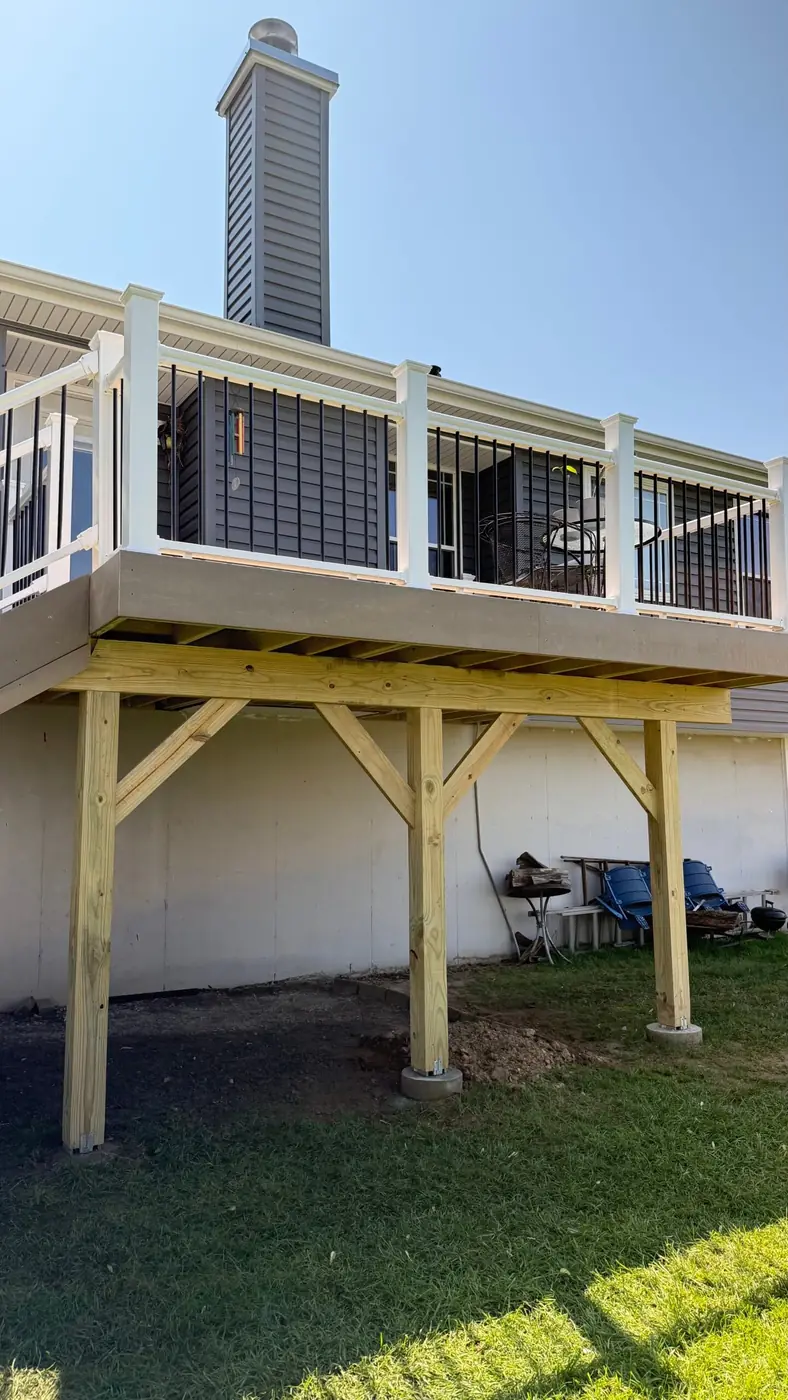
Every footing has to reach below the frost depth your building office sets, so freeze-thaw cycles in our clay-heavy soil don't heave the posts. A taller deck needs longer posts, more bracing and often bigger beams. Once the surface is more than 30 inches above the ground, the International Residential Code requires guards, which adds railing to the bill.
Depth matters too. A deck that runs 16 feet out from the house usually needs an extra beam line compared with one that runs 12 feet, and each beam line means another row of holes, another set of posts and more concrete.
Tearing out an old deck
Demolition takes labor, a dumpster or haul-away, and disposal. It also uncovers surprises. When an old deck comes off the house, the ledger area and rim joist get checked for rot, because a ledger nailed on without flashing has often let water into the house framing. Soft wood there has to be fixed before a new ledger goes on with lag screws or through-bolts.
Sloped lots
On a yard that falls away from the house, common in parts of Dardenne Prairie, Flint Hill and Augusta, the outside edge of the deck can stand several feet higher than the house side. That means taller posts, more bracing, a longer stair and a drainage plan so water doesn't pool around the footings. Tree roots on wooded lots can push a footing location over by a foot or two.
Permits
St. Charles County and the cities inside it require permits for new decks. Fees depend on which office covers your address, so a fair estimate lists the permit as its own line. Supreme Deck Builders handles the permit on the decks we build.
How do railings and stairs change the price?
Railings are priced by the linear foot and stairs by the step, not by deck area, so they surprise people more than anything else on a quote. A long, narrow deck carries more railing per square foot than a square one. A deck high off the ground needs more steps to reach the yard.
Railing materials
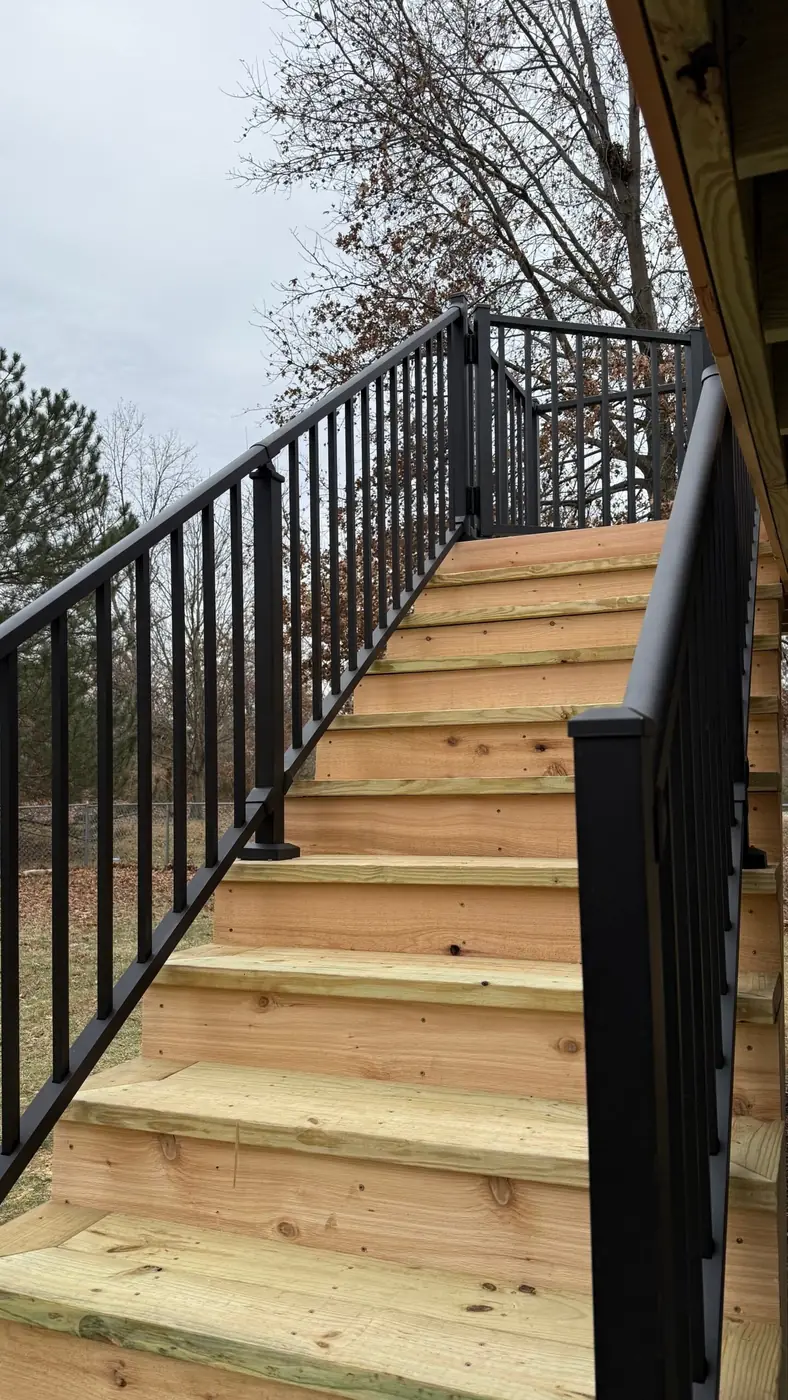
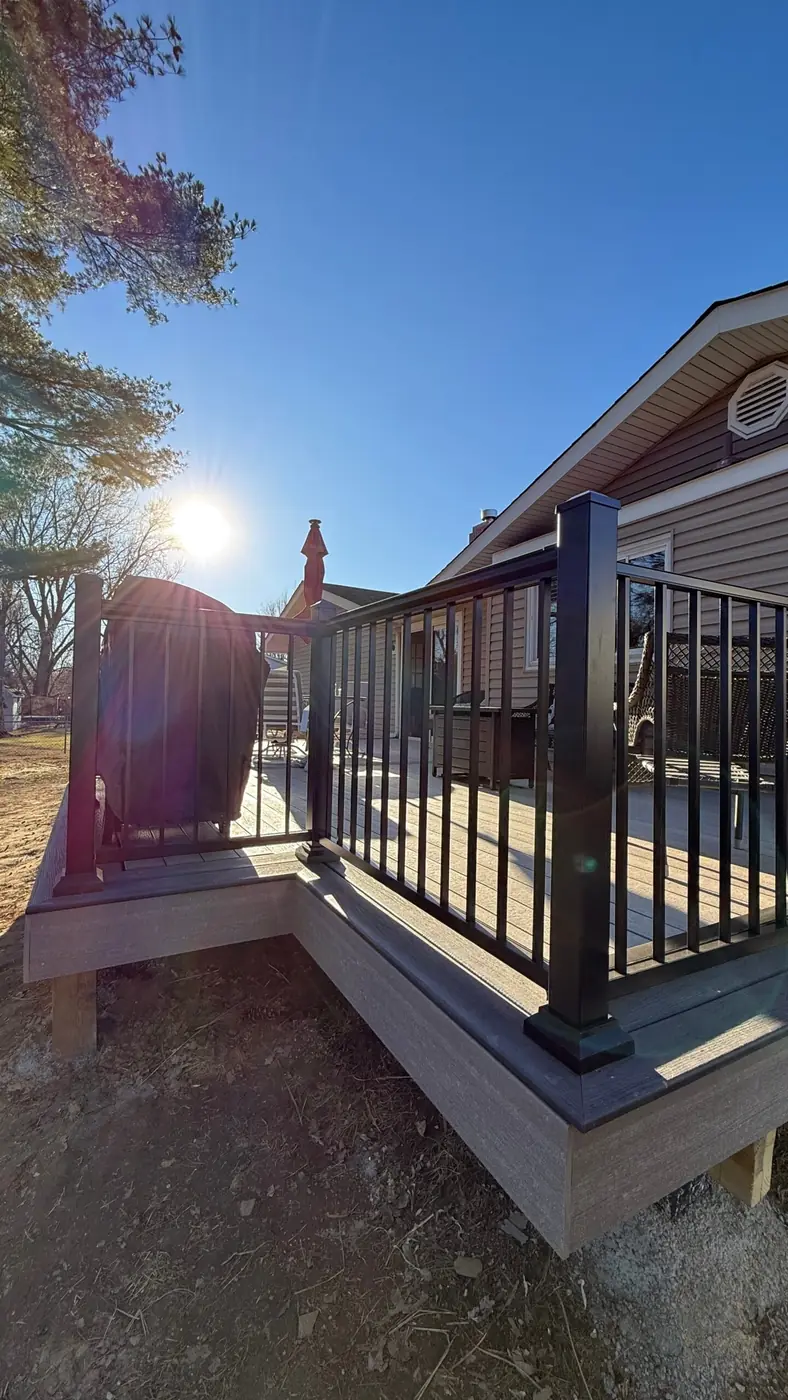
Wood railing costs the least to install and needs the same staining or sealing as a wood deck. Composite and aluminum railing cost more up front and need far less upkeep. A Trex deck with black aluminum railing is a common pairing for homeowners who never want to stain again. Railing systems carry their own manufacturer warranty, separate from the decking's.
Code shapes any railing. Guards on a residential deck must be at least 36 inches tall, and the openings can't let a 4-inch sphere through. That spacing sets the baluster count, and baluster count drives the labor.
Stairs
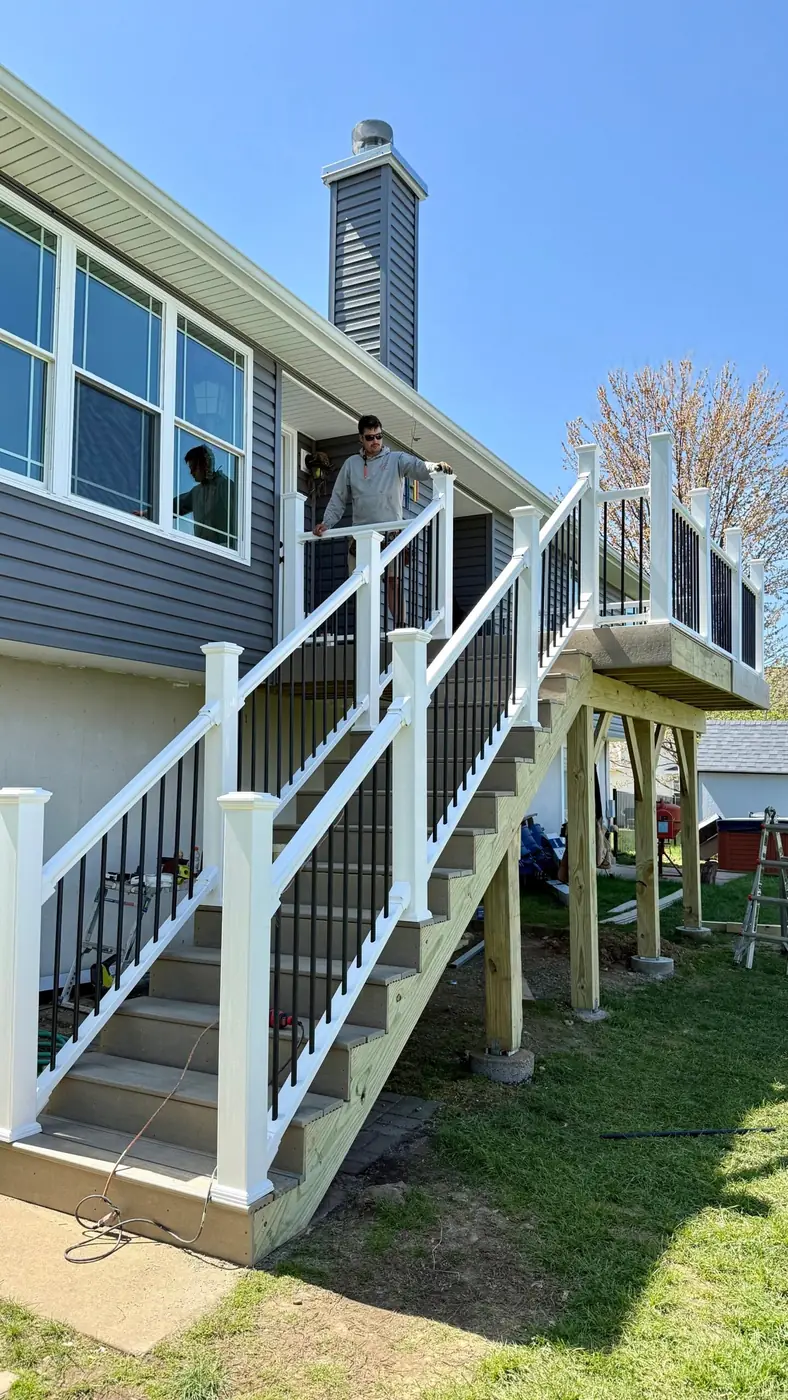
The IRC caps each riser at 7 3/4 inches and requires treads at least 10 inches deep. A deck 5 feet off the ground needs about eight risers. A deck 18 inches off the ground needs three. Stairs with four or more risers also need a handrail between 34 and 38 inches high. Each step adds a tread, more stringer and a bigger landing pad at the bottom.
Is it cheaper to repair your deck or build a new one?
Repair wins when the footings, framing and ledger are sound and only the boards or railings are worn. A rebuild makes more sense when the structure has problems, because paying to fix rotted joists and then paying again for new boards can land close to the price of a new deck.
When repair makes sense
Loose boards, a wobbly railing, popped fasteners or a handful of soft deck boards are repair work. Tightening connections, adding missing hardware, replacing worn boards and staining the whole deck can buy years for far less than new construction.
When to rebuild
Push a screwdriver into the joists, beams and ledger. If it sinks in easily, that wood is rotting. A nailed ledger, footings that don't reach frost depth, or posts sitting on bare dirt are structural problems that repairs rarely solve cleanly.
Does a deck pay you back when you sell?
Nationally, most of it. The 2025 Cost vs. Value report from the Journal of Light Construction and Zonda puts a wood deck addition at a $18,263 average job cost with about 94.9 percent recouped at resale. The same report puts a composite deck addition at $25,096 with about 88.5 percent recouped.
Those are national averages. The report's regional numbers swing widely from one part of the country to another, so don't count on the full national percentage in St. Charles County. Resale also only matters if you sell soon. If you're staying ten more years, composite's lower upkeep may matter more than a few points of payback.
How do you read an itemized deck estimate?
An itemized estimate breaks the deck into parts so you can see what you're paying for and compare bids line by line. If a quote is one lump sum, ask for the lines. A fair estimate in St. Charles County should show:
- Deck size in square feet and the decking product by brand and line
- Framing lumber and joist spacing
- Number of footings and their depth
- Ledger attachment, with flashing and lag screws or through-bolts
- Railing material and linear feet
- Stairs, with the number of risers and the handrail
- Demolition and haul-away of the old deck
- The permit and who pulls it
- Add-ons such as a pergola, privacy wall, lighting or under-deck drainage
- Fastener type, hidden or face-screwed
- Clean-up and a final walkthrough
Red flags on a quote
Watch for a price with no permit line, no footing depth, or the word "composite" with no brand or board line. Each leaves room for the final bill to grow. A bid far below the others often has railings or stairs left off.
How can you keep a deck's cost down without cutting corners?
Save on the parts you see, never on footings, framing or the ledger.
- Shrink the footprint. Dropping a 16x20 deck to 14x20 removes 40 square feet of decking, framing and footings.
- Keep it a rectangle. Angles, curves, picture framing and diagonal boards add cuts, waste and labor. Diagonal layouts also need tighter joist spacing.
- Pick boards by where they go. A mid-range composite line on top of a pressure-treated frame is the most common build, and the frame costs the same whichever board you choose.
- Phase the extras. Build the deck now and add the pergola next season, but plan the post locations and blocking at the design stage so nothing has to be torn open later.
Frequently asked questions
How much does a 12x16 deck cost in St. Charles, MO?
A 12x16 deck is 192 square feet. At HomeAdvisor's 2025 national range for installed composite, $25 to $54 per square foot, that's roughly $4,800 to $10,400. Pressure-treated wood usually lands lower. Height, slope, stairs, railings and demolition all move the number, so a site visit and an itemized estimate give you the real price for your yard.
Is composite worth the extra cost in Missouri?
For many homeowners, yes. Composite costs more up front but skips the regular cleaning and sealing that wood needs through hot, humid summers and freeze-thaw winters. Manufacturers back their composite lines with limited residential warranties. Wood recouped a little more at resale nationally in the 2025 Cost vs. Value report, about 94.9 percent against 88.5 percent for composite.
Does a deck estimate include the permit?
It should. Permit fees depend on whether your address falls under St. Charles County or a city like O'Fallon, Wentzville or St. Peters, so the estimate should show the permit as its own line and say who pulls it. On the decks Supreme Deck Builders builds, we handle the permit and the inspections as part of the job.
How long does it take to build a deck?
Most decks take one to two weeks once materials arrive and the permit is approved. Larger custom builds, multi-level decks and pergola combinations can run longer. Add the building office's plan review time before the crew starts, plus a free locate request through Missouri One Call at 811 before any footing holes are dug.
Why do deck quotes vary so much?
Contractors include different things. One bid lists railings, stairs, demolition and the permit, while another leaves them out to look cheaper. Footing count, board line and fastener type also change the price. Compare quotes line by line and ask each builder to name the decking brand, the board line and the footing depth in writing.
Talk to Supreme Deck Builders in St. Charles
Call 314-582-3861 for a free estimate. We'll come out to your home, measure, talk through composite, cedar and pressure-treated options, and give you an itemized quote. Supreme Deck Builders is based in St. Charles and builds decks across St. Charles County.
Talk to us about your deck
Call 314-582-3861 or send the form and we will set up a free estimate.
Talk to Kyle and the crew
Call or email, or send the form with a few photos of the space.